
A Matter Of Perspective II - Pine Needle Macros
Macro Perspectives With Pine Needles
MACROABSTRACTTREES
Aniruddha Bhattacharya
12/30/20256 min read
Guwahati
Pine ! And why not ? It’s the season for change after all and I have this macro lens that I’ve been wanting to flirt with for a while now. Writing out “A Matter Of Perspective – I” got me thinking about perspectives, which then got me thinking about pulling the 100 mm out for a little change of perspective. It’s finally time to get in tighter and that needs different tools. The telephoto that I usually carry about has its advantages for wildlife but its biggest limitation is the limited F stop range. The 100 mm has macro capabilities, goes from F 2.8 to F 22 and it’s been pretty much untouched for like over a year I think. I had fiddled with close ups years ago but they’re just so much easier to make on a mirror less camera in comparison to a DSLR cause of the live viewfinder. You also don’t have to be in a rush like with wildlife and it’s all a little easier for me now cause I know the camera better. Oh ! These old shoes actually got a lot more comfortable with age man.
There’s no denying that Macro Photography can make the main event out of what is usually the background for Wildlife and that’s quite a change of perspective. You’re now magnifying instead of zooming and getting a closer look in principle. In practice, you’re getting physically closer and using a different lens to change the whole perspective to a much smaller area. In the process, you’re making the background the foreground and discovering the background behind the current foreground as well. The wider range of F stops on these lenses can completely change the script of image generation in comparison to limited F numbers on telephoto lenses. Lower F numbers are awesome for sharpness when shooting Macro cause you need to get sharper as you get in tighter while upping the F number allows you to reveal more of the scene by pushing the curtain of blur backwards. The trade off is the shutter speed and tripods have to enter the game at higher F numbers cause there’s no point in pushing the ISO past a specific level where grain just kills details when the whole game is to get to details. These lenses allow you to play with varying levels of bokeh or DOF blur and its fun and artsy to do that while using the other fun tools that I’ve picked up along the way while doing Wildlife. The icing on the cake in a macro setting would be the entry of a tiny subject like an ant into the scene but then, that would bring up the discussion of using tripods vs using image stacking to get the mini subject in focus which I’m not gonna get into cause I don’t know it. I’m not saying never, but I’m not too keen on kidnapping garden creatures for a photo shoot just yet. Macro photographers are known to kidnap, freeze and subsequently end up killing their subjects all to get them to a little studio setting for the sake of well focused, stacked images. It’s not my scene at all.
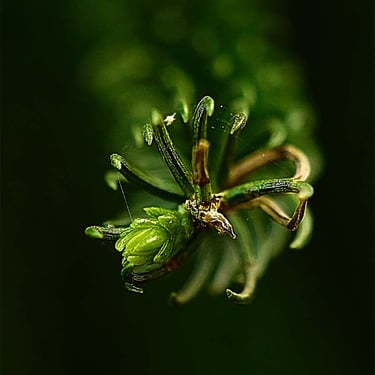
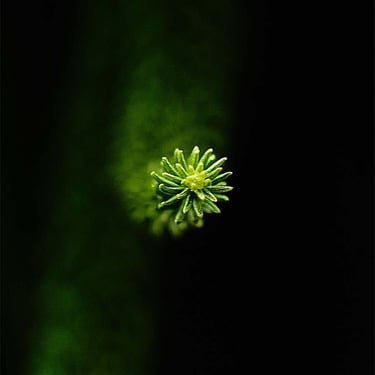
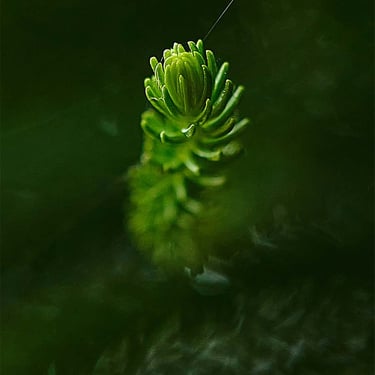
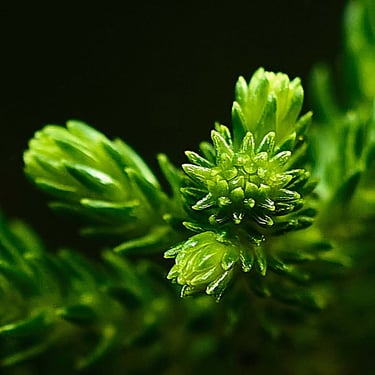
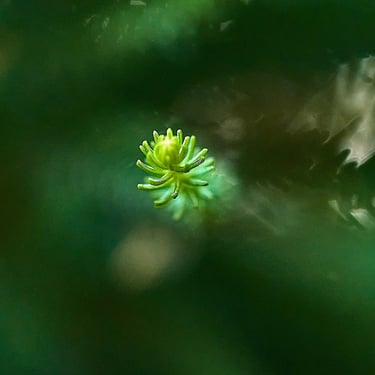
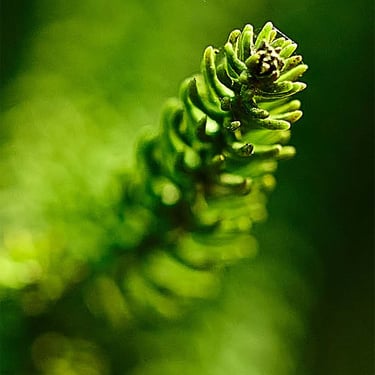
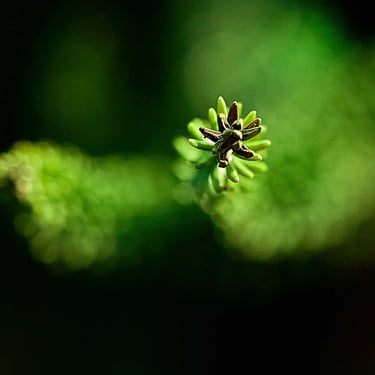
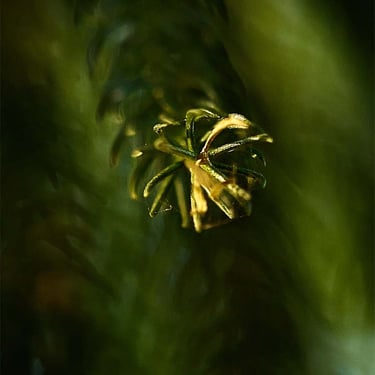
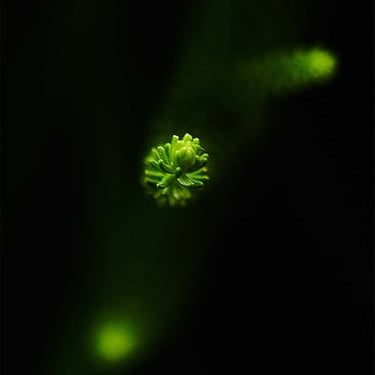
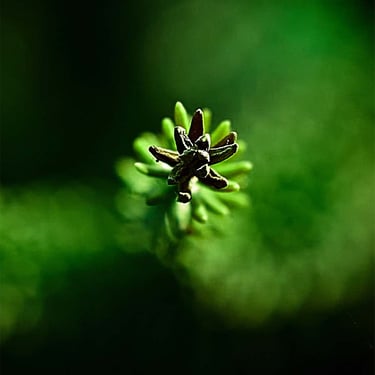
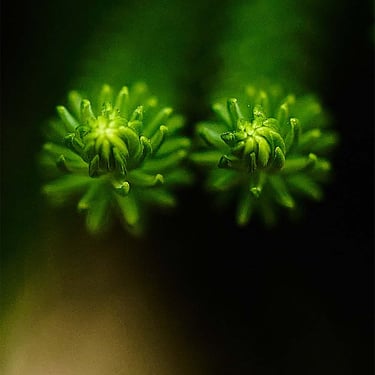
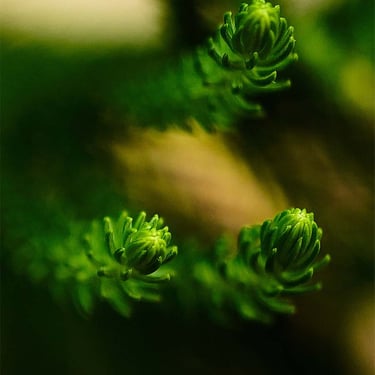
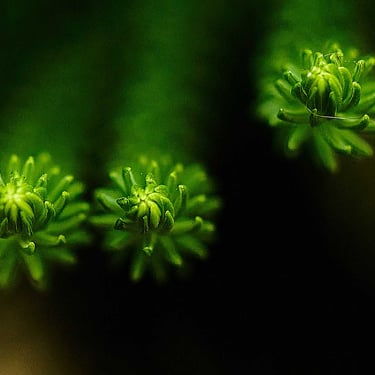
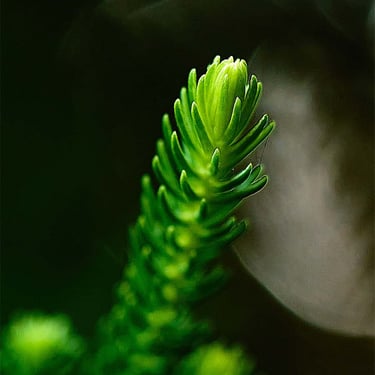
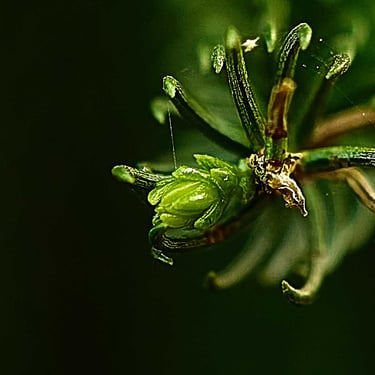
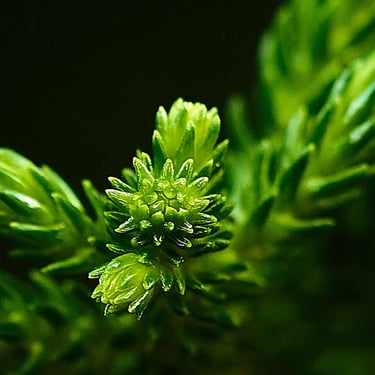
I was after the lighter green ends of the pine needles with this set. They might all look similar from our perspective but they’re not really similar as you can see. Each is different, unique and pretty impossible for our senses of touch and sight to distinguish between to the point of description. I chose F 2.8 as I needed the details of those ends sharp. I didn’t want the rest of the needles and tree behind my subjects in view and I knew that I’d probably black it all out by reducing general highlight in post to end up highlighting the lighter, more reflective tips which I was focused on. Going above the lowest F stop was dramatically reducing sharpness and clarity of the tips. The clearer background at higher F number settings was also too cluttered for much of my liking. There’s no doubt that the results would have been much sharper if this lens went to F 1.4 but then you also need a lens that lets you get close physically. Shooting from a greater distance at F 1.4 and then cropping off the advantages of the lower F number would be pretty counterproductive as crop reduces sharpness and more so for smaller details. So, a lens that goes to F 1.4 might sound pretty good, but it probably won’t provide much of an edge if you have to stand a distance away from a small subject for your lens to focus. It always comes down to tradeoffs with these lenses and I guess that you have to pick yours keeping in mind your specific needs and budget. The 2.8 suits me just fine for now for my occasional Macro and General needs. The 1.4 that doesn’t do macro is a great portrait lens for day or night. The 2.8 Macro hits a sweet spot for playing around with many kinds of photography.
Macro images take me to another world. It’s the world that hides in plain sight and yet we tend to not notice it because our senses just don’t gather that detail by sight or touch. We just don’t function at that scale It maybe fantastical to imagine turning into antman for a day and roaming a Macro landscape but a change in the scale of things would literally change reality for us. I wouldn’t know how to do anything in a Macro world. It’s such a simple fantastical concept and yet so difficult for me to totally get my head around if I think about it.
These pine needles are lighter at the tips and the light green naturally reflects more light than the dark. The small F number causes lens blur behind the focus point which is also lighter and reflecting more light here. When we lower highlight in these conditions like with the subjects in “ A Matter Of Perspective – I ”, the result on the final images makes me wonder if that perhaps is the reality of some of my small subjects because their smaller sensory organs would also be perceiving things in a limited way. A small shadow would be complete dark area for those little guys. The length of a pine needle would be a whole trek. I’m sure many of their little eyes don’t see beyond the length of that trek’s distance either and what’s DOF blur for us is possibly limitations of field of vision for them.
Sensory perspective influences perception which in turn effects decisions and behavior for all creatures including us. A world that we need to magnify to see is pretty mundane for the creatures that are operating at that level. We can all obviously only comprehend within the limits of our own equipment which could be natural or otherwise. Some small birds for example, have better eyesight than us. This fact alone makes that bird’s world completely different despite the bird’s small size. When you add ultraviolet colour vision and magnetic perception ( that birds possess ) into this mix of senses that influence perspective, the mix becomes something that humans just cannot grasp at all as we don’t have any idea at all about those senses. Yeah it’s a head f*** and yet, so amazingly beautiful simultaneously.
No matter what I do, I’ll never be able to smell as well as a dog or sense the earth’s poles on my nose as I’m flying around the world and that pretty much just sums up how it’s a different world with different perspectives for different creatures. It’s fascinating cause the fantasy of super powers is actually reality but just not for our species. Now, I might not be able to fly around without a passport but I can keep using the macro lens to try and peek into a different perspective of the world and I intend to do just that to see what else I can come up with. Playing with macro perspectives is fun and it gets me thinking and dreaming when I find the right shots for it. Let’s see how far I get I guess.
I finally got this site up to date this year and I’m pretty happy about that. This Blog got past 100 posts. I got an insight into primates as well who turned out to be quite a learning experience. Some new birds found their way into the galleries and narratives and it’s the introduction of Macros now. So not a bad year overall come to think of it. Here’s to hoping for many more adventures and fun times for us all behind the lens in the coming year. Happy New Year Everyone !
© 2026. All rights reserved.